


Our weather continues to warm up, despite the very cold days we had in the second half of last month. The average temperature was nearly 2°C above my 50-year average and 0.8°C above the average over the last 10 years, at 8.35°C. The lowest temperature I recorded was on the morning of 26th November; it was -2.5°C and the Mallard were walking across the pond on the ice. There’s a saying: ‘ice in November to bear a duck, nothing after but slush and muck’, meaning we could be in for a mild winter.
Mild weather very often brings rain and with 109mm falling, it was the wettest November since 1970, when 111mm fell. Looking back through the records, 1970 was the wettest November since 1829, which was when the local records began, kept by the local drainage board. 1829 was when two steam pumping engines were installed at Pode Hole, previous to that water was only pumped by windmills.
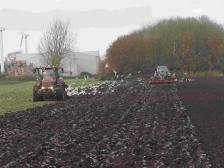
You might think that, as it was the wettest November since 1970, land work would have been brought to a standstill, but that was not so. Firstly, because we had such a dry summer and reasonably dry October, the land was still very dry underneath. All the wet weather has now brought the land back to as it should be, at this time of year. Secondly, as it was a fairly dry autumn, we had lifted all the potatoes and the drilling of all the wheat completed, so there was only the ploughing to do, and that has been going well.
There is less ploughing being done now than in the past; in fact, if all your crops go through the combine, there is really no need to be doing any ploughing at all. We plough less because it is expensive and not good for the soil – the less we move the soil, the less invertebrates that are killed, and insects make holes in the soil for the water to drain away.
We have tried not ploughing for sugar beet, but we had a reduced yield, whereas in some parts of Norfolk the same technique that we tried gives a 25% yield increase, which didn’t work for us. On all land, except the lightest, we need to plough for potatoes.
All in all, it was a good autumn, it was nice and dry for us to lift potatoes and drill our wheat. Now the land is wet right through, ready for the spring crops, but we are not making any money.
Apart from the good weather we’ve had this last year (in sharp contrast to the two previous years), arable farming in the UK is under a lot of pressure at the moment. Potato prices are at rock bottom and wheat prices are the same as 30 years ago; other commodities, like barley and peas, are also not fairing much better. Our wheat and grain prices are largely based on global markets.
The government’s Basic Payment Scheme, which acted as a safety net for farmers and crofters by supplementing their main business income, is also to be phased out by 2027.
With all this, plus the much published inheritance tax rules, many farmers and farming companies are questioning what their future is. Recently Velcourt Farms, a contract farming company farming 57,000ha, have announced they are cutting back their farmed area by 20% next year. Another large farming business local to us, supplying supermarkets with fresh produce, has also been in the press recently, with large financial losses.
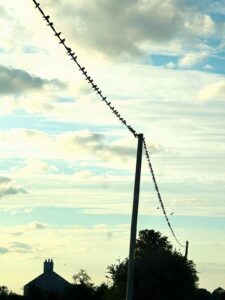
As predicted, we had a large increase in winter visitors to the farm in early November: 2,000 Lapwings, 2,000 Golden Plover, 3,000 Starlings and up to 200 Fieldfares. Not so many Fieldfares as usual, but many could have over flown us and gone straight to apple orchards in the West Midlands. Starling numbers have increased further, and we have had about 10,000 roosting in the reeds around our reservoir, and we’ve seen some nice murmurations.
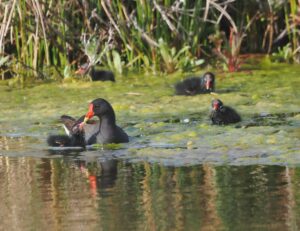
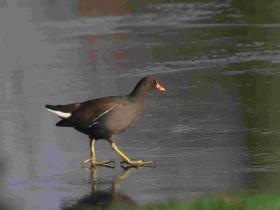
Moorhens have been of interest this month. On the pond by the Café, about 18 or 19 were reared and on the pond by the Vine House Farmhouse, only three were reared, despite feeding them with wheat on both ponds. Most have left the Café pond, with several moving to the pond near the house. A few must have gone elsewhere or maybe a stoat, weasel or mink had taken up residence around the Café pond, and eaten one or two, frightening the rest away.
Tree sparrows had a reasonable breeding season. They are rearing more than enough to increase the population here, but young Tree sparrows disperse around mid-September. They will travel more than five miles, but less than 100 miles. They are birds of the countryside and as we get very few recoveries from ringed birds, our knowledge of what they do is rather scant. As there aren’t many colonies around here, we’re not getting many replacements to our colonies. South of us here in Lincolnshire, Tree sparrows are a rare bird.
We know so little about wildlife; we have no idea why Tree sparrows are more numerous North of Lincolnshire. A species starts to decline when it doesn’t have enough food; we know insects are in decline and I know from my nest records that they are not rearing as many chicks per brood as they used to. They are also not laying as many eggs as they used to and that will be because the insects are not there. They cannot take water to their young, so the moisture the young birds receive must be included in the food and that moist food is insects. I feed them with seed all year round.
Although they are called ‘Tree’ sparrows, everywhere I have been in Asia there they are chirping away on the top of a building, quite often in a treeless area. In Siberia, just below the Arctic Circle, all over China and Tibet, even at Everest base camp and they’re sold cooked in Saigon, ready to eat. It must be our intensive farming, dense population and all the trappings that come along with a wealthy society that make a habitat that is impossible for them to survive in.
Again, disappointingly, our wetland is not attracting many Wigeon. Five years ago, there would be over 1,000 Wigeon wintering on it, but today there are only about 50 Teal.
On behalf of all the team here at Vine House Farm, I’d like to wish everyone a very Happy Christmas, and thank our customers for their support over the last year. Best wishes to all for 2026.
Related Articles