



Linnets and their survival
View All BlogsFarmland birds are declining but there are ways in which farmers can help to prevent this. Here Nicholas Watts discusses the decline Linnets and what can be done for their survival.
Linnets are another farmland bird that are, or used to be, widespread throughout lowland Britain. In the uplands they are replaced by the Twite and both have undergone a massive decline in the last 50 years.
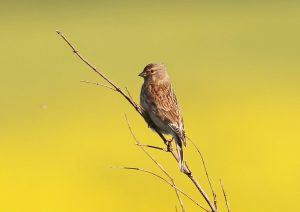 Mechanisation has revolutionised farming; 60 years ago the binder was still the most common way of harvesting our grain crops. Basic weed killers were being used, which only killed about half of the weeds in the crops so there was food everywhere for small seed-eating birds. Each year small improvements are made to the growing and harvesting of our crops, with absolutely no regard for our wildlife.
Linnets are birds of the open country, not usually seen in gardens which is unfortunate for them as they could find plenty of food at garden feeding stations. When you look around farmland today, where can you find broad leaved weeds going to seed? Gone are the days when chickweed and groundsel would be going to seed in the winter wheat crops during April.
Today most of our crops are weed free and the machinery that harvests them is speedy and efficient, leaving very little waste. Gone are the hay meadows which were made up of 20 or 30 different species of plants. Grass fields are all rye grass now and harvested for silage before anything has time to go to seed. This has resulted in very little food for seed-eating birds on an efficient farmer’s land. Very few people noticed the decline of our seed eating birds, those that did were, and still are in the minority and so the drive for efficiency continues.
The Game Conservancy were pioneers in trialling crops to help our farmland birds. It was in the late 1990s when there were options for farmers, in Countryside Stewardship schemes, to grow seed bearing crops for birds to feed on through the winter and that has certainly helped our seed eating birds through the winter. These crops don’t usually last after March and then comes the gap when there are very few seeds available. The first ones are groundsel or dandelion, unless they can find a farmer who is feeding the birds through the winter.
Linnets, like most passerines, would like to start nesting in April, but if there is not much food around then they are not able to get themselves in breeding condition to start nesting. Many have to wait until the Oilseed Rape produces seeds, which means plenty of food is available, but will only last for a month or six weeks. This results in only a single or double brood instead of two or three and this is why they are in decline. This decline has caused them to be another farmland bird placed on the Red Data List.
Linnets like to nest in small bushes, maybe an evergreen one for the first brood. A nice little thorn bush is ideal as, once they in full leaf, the thorn bushes are impenetrable to those marauding Magpies.
The nest is built by the hen bird, and made up of grasses, twigs, bents and sometimes mosses and lined with horse hair or wool. Four to six eggs are usually laid and incubation takes 12 days. The young are fed initially by the cock bird as the female will be brooding, and latterly by both parents. 
The best way of finding Linnets nests is to go along with a stick tapping suitable habitat waiting for the hen bird to jump off the nest. They can also be semi-colonial nesters and like to feed in parcels, even in the summer.
Linnets are different to most farmland birds, who would feed their young on insects, instead Linnets feed them on unripe seeds. They collect these to store in their crop, enabling them to travel a mile of two away from the nest to collect seeds.
However, those small parcels could well be birds that are not breeding, because they are unable to find enough seeds to start breeding. Linnets will come to a feeding station out in the open country.
One of their favourite seeds is the Oilseed Rape which is available on nearly every farm in the eastern counties. When the wild bird cover crops start to run out of food, I sprinkle some oil seed rape on a track and soon see a parcel of Linnets feeding on it. Other birds, such as Wood Pigeons, Stock Doves and Pheasants will try to muscle in on this seed, so I cover it with wire mesh which excludes everything bigger than a Mistle Thrush. The wire mesh I refer to is 2ins x 4ins and was commonly used by small farms to make a grain storage bin in the 1960s and can still be found on small farms at the back of the yard somewhere.
 As Linnets will travel for up to a mile to find seed when nesting, one or two of these feeding stations will feed a big area. Oil seed rape is 40% oil so Linnets take dried or mature rape seed to their young. Like other species it is not just the adults that need the food to feed their young; the young need a plentiful supply of food when they have fledged as they are inexperienced in finding food.
It is estimated that only about a quarter of young birds of most species, in normal conditions, survive to breed. This is frequently due to running out of food at sometime during that first year. We would obviously like to see more Linnets, but to see more Linnets they need a surplus of food, so we need to make an effort and feed Linnets with Oil Seed Rape.
For more information see the ICUN Red List of British Birds