

Global warming is certainly happening – my thermometer says so, and all the reports we hear on the TV and radio say so. This July has been 2°C above my 50-year average of 16.9°C. The months of July in 2022, 2018, 2006 and 1995 had higher day temperatures, but it is our warmer nights this year that have made a difference. 14.2°C was our minimum night temperature this July. It has also been quite dry, with 38mm of rain, our average being 48mm.
The first half of July was hot at times, but on July 15th it rained. St Swithin’s Day is also on 15th July and, according to traditional folklore, whatever the weather is like on St Swithin’s Day – whether rain or sunshine – it will continue for the next 40 days and 40 nights. The weather has been unsettled ever since!
It has held the harvesting up now and again, but I feel we are better off without the extreme heat as our crops, and most of us, didn’t enjoy it. However, the dry weather has also been a good thing, as the last two autumns have been too wet. This meant we were on the fields when we shouldn’t have been, and our tractors caused the soil to compact. The dry weather has cracked our soil open, and all that compaction has gone.
All last year’s potatoes have been sent away, all for human consumption. A month ago, we thought some of them might have to go at a rock bottom price for animal feed. Our potato stores are being brushed and hoovered out when there is a break in the harvesting. Irrigating the growing crop is still going on; we need size as well as yield, as a bold sample could be worth a lot more than a small sample. It is the baking sized potatoes that carry a premium price.
All next year’s cropping has been worked out, and most of the seed we need has been bought or saved from the top yielding varieties we’ve grown, of wheat, barley, millet and canary seed.
There are extensive variety trials going on all over the country for wheat, barley, oats, peas and beans. Millet and canary seed are such minority crops that there is very little research being done on them, as the reward for bringing out a new variety is not very great.
New varieties of wheat, barley and oats are being introduced each year, and of course we must weigh up the pros and cons of which, if any, new variety to invest in. Do we go for a wheat variety that will go for making bread, which yields less but attracts a higher price per tonne? Or do we go for an animal feed variety, which yields more?
Our experience has shown that if we sow a bread making wheat on our Fenland fields with a clay subsoil, it does not grow a good bread making sample, so on those fields we go for varieties that have the biggest yield. It does help to have some experience of the land you are farming, and a weighbridge on the farm.
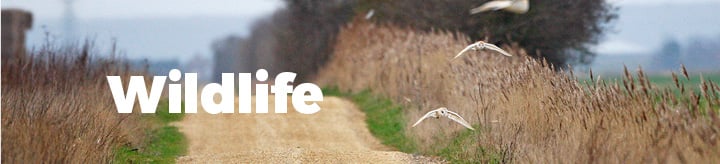
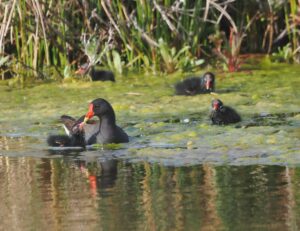
The Moorhens in the Café pond have been doing very well this year. They have had three broods of six or seven. I presume they are preparing for a 4th brood because the other day, I saw one adult standing on the back of the other adult – I can only assume what they were doing!
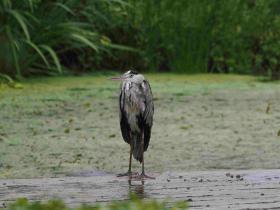
Over the past week, we’ve had a Heron visiting the pond; it comes late in the evening, or early in the morning, so none of our Café customers will have seen him. If it moves and can be swallowed, it is fair game to a Heron. The first and second Moorhen broods are too large, or too feathery to be swallowed, as they would not slip down its throat like a fish would. I keep frightening the Heron off, but he still feels it is worth coming back. There were six Moorhens in the 3rd brood and now there only seem to be three. Will it get all the 3rd brood?
There must be a few more voles around now because three more pairs of Barn Owls are now brooding eggs. When I wrote last month’s newsletter, I only had one pair nesting on the farm, and they had four young.
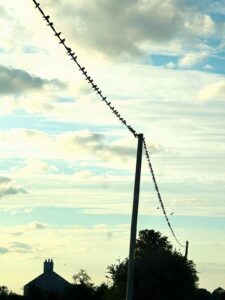
We’ve had an increase in Swallows at our Baston Fen farm. We have three pairs nesting there this year and I should think it is because of our free-range chickens. Flies live around animals and birds. There used to be a lot of insects living in our crops, because there were a lot of different weeds in them, but not anymore, due to all the chemicals we have been applying over the past 40 years.
We’ve been applying them to increase our yields, and now we are wrong for using them – but no one could see the long-term effects all these chemicals would have. Some of them are extremely powerful, we might only use 30g per acre. Our agronomist advised us to use them and all those used have been approved by the Ministry of Agriculture, so whose fault is it for the decline in insect life?
You may be aware that there has been an increase in butterflies this summer. In 2023, my peak count down our Butterfly Walk was 105 and in 2024, I only counted 65. This year, my peak count was 150, but 60 of those were Peacocks. Three days later, my count was 95 and Peacocks were down to only four. Peacocks are a wandering butterfly, we’d hatched them all and they had gone wandering. Let’s hope they found somewhere nice to wander to.
Apparently, many of those Peacocks will still be about to hibernate and then go on to wake up in the spring and produce the next brood of caterpillars in 2026. Without that large increase in Peacocks, we would’ve been back to 2023 numbers. Tortoiseshell used to be a very common butterfly; I can remember counting 58 one day in our garden about 10 years ago, but I have rarely seen more than one a day this year. Tortoiseshells lay their eggs on nettles, so it is not that their food plant that has disappeared.
Related Articles