


It was a very pleasant September but not the warmest, with a mean of 16.6°C. We’ve had four warmer Septembers and with only 26mm of rain, dryer than average.
The rain at the end of August came just in time for us to drill the rape seeds. It is up and trying to grow, but the flea beetle is attacking it. The soil is now very dry and so the rape is only growing very slowly, but the flea beetle continues to thrive. We need some rain.
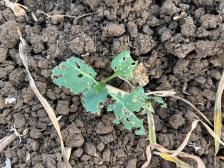
The Flea beetle is a small beetle, about 2mm long, and appears in such large numbers that they will eat nearly all the rape crops sown in a district; thousands of acres. There isn’t a spray we can use to kill them. There was a chemical that would kill them, which has been withdrawn – the neonicotinoid insecticide that disorientated bees. We used it on sugar beet to keep the aphids away too – if you see a sugar beet field looking rather yellow, it may well have been attacked by aphids, greatly reducing the yield.
In the next few days, we will have to decide on whether we’ll keep our rape crops or plough them in. We chose to drill more rape this year as we believed it could be successfully established and reduce our reliance on spring sown crops, which suffered terribly due to the very dry conditions this spring and summer.
The price of wheat has increased by 15% due to the drought in Europe, but wheat is easily transported around the world, so there will be no shortage of bread or wheat related products this winter.
Potatoes and vegetables may be more of a problem. Potatoes have quadrupled in price on the free market, but there could be as much as 70% of potatoes grown on a price contract, so you will not see prices rise much in the supermarkets.
Potatoes are an expensive crop to grow. It only takes 5 or 10% surplus for free buy (non-contracted) prices to halve. So why not sell more on contract to the packers, I hear you say? Well, we do contract many, but we often feel that the contracts are not a great return and quality can be subjective. So, by that I mean in a low priced year, suddenly we hear stories that contracts have been rejected due to quality problems. In contrast, during higher-priced years, there never seem to be such problems. The packers have an incredibly difficult job trying to make a profit, quite often dealing directly with supermarkets and we all know how difficult that can be.
Brassicas will be in short supply because most of the growers around the Wash, one of the main UK brassica growing areas, are unable to irrigate their crops. The soil is the best there is, but brassicas need to be planted all through the summer and there were a few weeks in late July and August when growers were unable to plant, leaving potential gaps.
The only birds still breeding on the farm are Wood pigeons, Stock doves and Barn owls. It is the Barn owls I am more interested in; by the middle of August, it looked quite exciting – I had seven pairs on a second brood, and they averaged 6.5 eggs per brood. I then went to Turkey for 18 days, and on my return, I found only three nests surviving out of the seven and with just two young each. Those deserted nests still had eggs in them.
The hot dry weather during August not surprisingly must have stopped the voles breeding and suddenly they are in short supply, but only last week I saw a young Heron catch a vole in the free-range chicken grass field and two days later there were seven Herons in that grass field. If it moves and can be swallowed, it is food for a Heron.
All our breeding Swallows left on September 12th. I was seeing Swallows up to the 20th but none since. During August, we had up to 100 Swallows collecting on a telephone wire at our farm in Baston Fen. We don’t see so much of that now, for two reasons. Firstly, because we don’t have so many Swallows and secondly, which is also why we don’t have so many Swallows, there are less insects about and so they must fly more and therefore spend less time sitting on wires. As there are less insects, they leave us four weeks earlier than they did in the 1970s, according to my diaries.
October is the time when we see the least birds on the farm. Our summer visitors have left and we are waiting for our winter visitors to arrive. Our resident birds, which have declined in numbers, are moulting into their winter coats. They are mostly keeping out of sight as when they are moulting their wing feathers, they are unable to fly as fast as they normally do.
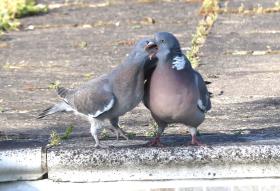
The water feature in our garden is dominated by Wood pigeons, they are still breeding and continue to breed as long as they have access to grain or seeds and water. They have the ability to eat dry grain, then go for a drink and their digestive system will turn the seed and water into pigeon milk, which it regurgitates for its young to take, as seen in the image below. The pigeon only lays two eggs because its digestive system will only work fast enough to provision one chick; two adults can only provide for two chicks. Despite it only laying four to six eggs a year, less than all our farmland and garden birds, it has until recently still been increasing in numbers.
My wife Anne and I went to Turkey by train; we travelled by day and spent each night in a hotel. Not the cheapest way or the quickest way of travel, but I am a farmer and I like to see what is going on in the countryside. It took us five days to get to Istanbul and five days to get back and was one big geography lesson from start to finish. In Turkey, we went to see our supplier of sultanas, which we use in our Ground Mix. The harvesting of all sorts of crops was in action in Turkey. In days gone by, here in the UK, we would be salting and pickling food for eating in the winter, but in Turkey they dry their food in the sun to preserve it for the winter. A fascinating holiday.

Related Articles