


We had quite a good August really, the last few days might have spoilt it, but it was over 1°C above the monthly average of the past 50 years, at 18°C. We missed some of the heavy showers and only recorded 12mm of rain here.
The weather has been kind to those who have been harvesting with the combine, but not to those who have been harvesting potatoes. Neither has it been kind to those who have been trying to get things to grow, as during the first 26 days of August, we only had 2mm of rain. It is rape seed that I am mainly thinking about.
When harvesting potatoes, the soil really needs to be moist, so that the potatoes ride on a cushion of soil most of the way up the harvester. If the soil is dry, it falls through the webbing, and the potatoes are then riding on metal bars and will get bruised. A bruise on a potato is a black spot under the skin; no doubt you have seen these black spots in potatoes on your plate.
Our wheat and barley harvests were finished on August 12th. In 1976, we finished the harvest on July 31st; that really shows how much drier it was then. The drought of 1976 was broken by 4ins or 100mm of rain during the last three days of August. This made the total 8.7ins or 220mm for the first eight months of 1976. This year, we had 210mm of rain in the first eight months. Another feature of 1976 was how dry the 1975/6 winter was. Winter 2024/5 was very wet up to the end of February.
The wheat and barley harvest weren’t good; yields were down from our average over the past 10 years, but it was a cheap one as we haven’t had to dry any of it. The UK will probably be nearly a million tonnes down on the average tonnage grown. You would therefore expect the price of wheat and barley to be up but it isn’t, the price has been falling for the past three months, and it is now about £160/tonne. You would think that, as we have grown less tonnes than usual, the price would go up, but the price we receive for our grain is the world price, and there is just too much grain in the world now.
We are cushioned to a certain extent from the low price of wheat as about half of our wheat goes to feed our chickens and so the food for our laying hens has been very good value these last few months.
Sheep and cattle prices are at record prices, and it will cost less to feed them as grain prices are so low. Livestock farmers deserve a few good years, as for so long they have endured low prices. Us arable farmers can put our machines in a shed and go away for a few days, but cattle and sheep must be looked after, or looked at, every day of the year.
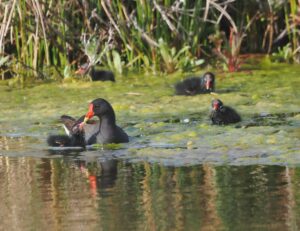
A Heron continued to visit the Café pond until there were only two out of seven left of the third brood of Moorhens. With only two youngsters left, it must’ve thought it was not worth returning. A fourth brood of four Moorhens appeared around August 22nd. They are well looked after, as the grown-up chicks from the first two broods are helping the adults to look after them and provide them with food.
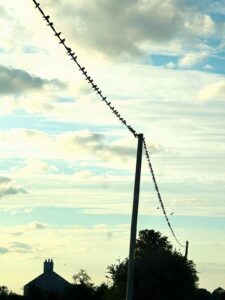
Our summer visitors are slipping away; those that haven’t gone are busy looking for food in vegetation and keeping quiet. We can still see Swallows and House Martins, but they are also moving south. All our other smaller birds finished breeding by early August, but Swallows and House Martins feed on the last stage of the insect’s life, the flying stage, so they are still able to feed young in the nest, quite often into September.
We let the Turtle Doves go, from their release pen towards the end of May, but still provide them with food and water near the release pen should they need it. Things were a bit quiet in June and July, but we are now regularly seeing 15 or 20 young Turtle Doves flying around the farm at Baston Fen. Our breeder, Trevor Ley, has been very busy this summer and has reared about 1,000 Turtle Doves and has delivered another 100 for us to over winter. During the summer, he has caught several Doves that he has bred in previous years, one from 2019. Any donations would be very welcome, as we have not been able to get lottery funding yet. If anyone feels they could make a successful lottery bid on our behalf, we’d welcome hearing from you. Donations can be sent by cheque to Vine House Farm or can be given directly into the Turtle Dove Trust account, via the website: www.turtledovetrust.org.uk
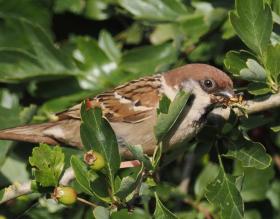
The Tree Sparrows on the farm have had quite a good year, but it is a job to say what is a good year for a decreasing species. Tree Sparrows are declining in Lincolnshire, and to the South of Lincolnshire, because they are unable to find enough food in the countryside. However, in North Lincolnshire, they do a lot better. We know so little about wildlife; we have no idea why they survive better in the North of England. Young Tree Sparrows disperse from where they were reared around the middle of September. Our colonies here need birds to come from the surrounding countryside but being as there aren’t many Tree Sparrows around in South Lincolnshire, we’re not getting many new birds coming into our colonies and so numbers are declining.
I say the Tree Sparrows on the farm have had quite a good year, about 200 have been reared in 37 nest boxes. But they are rearing less birds per box and less birds per brood than they used to, and they no longer rear any broods of seven. I put all this down to a decline of insects. If we were to double the amount of flower margins that we already have, it may well help our Tree Sparrows and of course other species might be able to rear more young as well.

Related Articles