

September was an average month with an average temperature of 14.6°C. It was 0.5°C above my 50-year average, but 0.3°C below the last 10-year average. Yes, there is no doubt that we are warming up. Rainfall was 48mm, just a few mm above the average for the month.
Despite having above average rainfall for the month, the soil here is still fairly dry, quite different to the last two years when it was plenty wet enough and our tractors were causing compaction. The dry summer has helped us, as it has cracked the soil open and removed the compaction that had been caused over the past two years.
Nearly every farmer now has his combine put away for the winter, but we still have the sunflowers to harvest, and they will be harvested earlier than normal due to the warmer than average summer. The millets were also harvested earlier than normal, not a particularly heavy harvest, and fortunately before we had a storm with strong winds. A storm shakes the heads around and half of it can then be lost on the ground.
The potato harvest is underway; by the time you will be reading this half will have been harvested. Despite the dry weather, we have a good crop, but only due to all the hours our men have spent moving the irrigation machinery to keep them growing. The dry summer, and as several growers had no irrigation, has meant the total crop will yield less than usual. The price of potatoes has come down to the point that there is very little profit in those crops that are not on contract. About two thirds of our potatoes are on contract this year. The problem being is that last year’s potatoes were still being sold in shops right up to the middle of September, when usually they would all be new season by the start of August. Effectively, this gives us 11 months of sales, instead of 12. Because we can keep potatoes so well these days, there is very little difference between old and new potatoes, and a lot of people would be unaware that they were eating potatoes that had been in store for eleven months.
Maximising yield by producing a consistently nice looking crop – good skin finish, a regular shape and size of tuber – is imperative when trying to sell to supermarkets. Irrigation not only helps with yields, but also the skin finish and size consistency. The soils between Skegness and King’s Lynn, the grade 1 silts, are good and always seem to have moisture to produce good quality crops without the need for irrigation. However, here in the Black Fens, we usually need to irrigate crops.
We are now drilling our winter barley and winter wheat crops. Winter barley is normally drilled before winter wheat and most of that will be drilled by early October. Winter wheat will be drilled right through until late January. In Eastern counties, where sugar beet is grown, wheat will still be being drilled, if ground conditions allow, up to mid-February.
Thank you to all who donated to the Turtle Dove Trust. Not having a lottery grant, we are not running with a surplus and all donations are gratefully received. We have three Turtle Doves with trackers, and one of those is now in Spain, steadily heading its way south. We have received another 100 Turtle Doves that our breeder has bred this year that are in our Vine House Farm release pen, and we will be releasing them next May. Please see www.turtledovetrust.org.uk for more information.
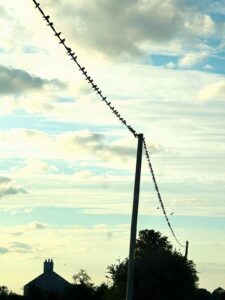
All our local Swallows have departed, I just see the odd one or two passing through. Our Swallows stayed a bit longer this autumn and reared a second brood, but out of the five nests I monitored this year, four of them only reared three and the 5th one reared four chicks. That is not enough, they should be rearing five chicks to keep their population stable and I presume they are not rearing five because they cannot find enough flies.
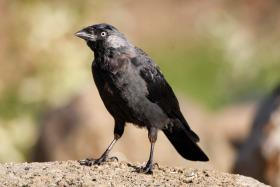
I am often told about Jackdaws that have taken over an Owl’s nest box, and my comment has always been that if a Barn Owl wants a nest box, it will see the Jackdaws off! But let’s think what might really happen. Outside the breeding season, Jackdaws roost communally with Rooks. They fly off at dusk to their roost and return after dawn and, at some time in the autumn, they start nest hunting. Meanwhile Barn Owls have been out looking for voles and they return to roost at a nest site before dawn. Jackdaws may well come to a nest box where a Barn Owl is roosting and I would think that if a Jackdaw sees a Barn Owl in a nest site, it will quietly go away. The Barn Owl is better equipped if a fight should occur, but I have no idea if fights do occur.
If you would prefer a Barn Owl to be nesting in your Barn Owl box which has been taken over by Jackdaws you should go to it in July, which is after the Jackdaws have finished nesting. Clear out all the twigs in the nest box, so there is room for an Owl to inhabit it, should one be in the area. It is surprising how difficult it is to get all the sticks out, but if you want the Owl back, this must be done.
Barn Owls are specialist hunters and if voles become scarce, they don’t breed and sometimes die because they are unable to find enough food, as has happened in large parts of the country during the winter of 2024/5. Jackdaws are omnivorous and so if one food source fails, they will go and eat something else. In general, the crow family get on well with our lifestyle, roads provide them with food, Carrion crows and Magpies can live in our cities and I believe that the Carrion crow will be one of the last birds to become extinct. I believe that the population of all species of the crow family in the UK is increasing. Roads and houses are not good places for Barn Owls.
I would be interested to hear from anyone who has any photographic evidence of Jackdaws and Barn Owls in the same nest box.
Related Articles