


The 53mm of rain that fell in December was about 10mm above the average. As well as December, January and November had above average rainfall too, making the total 477mm or 18.9ins for the year. This is just 2ins below the average here at Deeping St Nicholas. However, the temperature was 2°C above the 50-year average; we’ve had three warmer Decembers, and they have all been during the last 10 years. 2025 was as warm as 2024 and they are the warmest years I have recorded.

Whilst the wet weather continued for the first two weeks of December, it didn’t inconvenience us very much on the farm, as we had most of the work done by the end of October. The weather was the best part of 2025 – a warm dry summer with above average sunshine, an easy autumn, then heavy rain in November and December. The worst part was the prices of all our crops – they were down and are predicted to be down even further for 2026.
It all starts with wheat, with the world price predicted to be low in 2026, so every other forward crop price is down. We have the option to sign a contract for most crops or grow on the free market. The only crop we do not have that choice is sugar beet; growers must grow at the contract price or not at all. There is also the farm inheritance tax fiasco which will not affect me, but may well affect future generations.
Fortunately for us, chickens and their eggs are one of the few commodities that are not down in price, and because the price of wheat is so low, it has been cheaper to feed our hens.
With nearly every agricultural product being down in price, you might think that prices to consumers might come down too. Unfortunately, that will not happen, as there is inflation in the form of wage rises to all businesses. A £20/tonne reduction or increase in price means a lot to a farmer, but it only equates to 1 pence per kilo.
With all the wet weather, the pipes we have had laid across our fields, three or four feet down, are now running well. They do need some maintenance and we have a machine with a long pipe that makes its way up our field drains and flushes silt or ochre out of them. One jet of water comes out the front of the nozzle, and three jets come out the back, and it is these three jets that power the pipe forward and flush the sediment out of the drain. Not all fields need these field drains; if the subsoil is limestone, the water will be trickling through the stones to fill our aquifers up. You could say the water that comes out of our drains goes to waste, but it goes out to sea to help make more rain.
Despite the heavy rain we had in November, I have not seen any large puddles on the fields. This was due to the compaction that was caused in the two previous wet autumns, then put right by the dry summer, cracking the soil in numerous places.
I have never seen so many berries on our hedges at this time of year, as there currently are now. Whenever I collected holly in December for Christmas decorations there were none, the birds had eaten them all, but now nearly every holly bush still has berries on it.
There are a couple of reasons for this. Firstly, the abundance of fruit on every bush and tree is a result of the above average sunshine we had throughout the summer. More sunshine means more insects flying around to pollinate flowers.
Secondly, we had a lot of southerly winds this autumn and those winds continued past us, right up to Norway. Many of the birds that normally migrate to us do so to get away from the frost and snow in Scandinavia. The species that cannot find food when there is snow on the ground – such as Blackbirds, Fieldfares, Redwings, Wood pigeons, Starlings, Robins, Lapwings and Golden Plover – didn’t dare to cross the North sea headwind, so some will have gone south by the way of Denmark and Holland.
This means we’ve not had so many birds to eat that abundant crop of berries. Others might well have waited for favourable winds. The northeast winds of these last 10 days have brought Fieldfares to our hedges.
Last month I talked about tree Sparrows on the farm dispersing around the middle of September. Tree sparrows are not the average Sparrow you have in your garden; they are most likely to be House sparrows which don’t disperse in September. If you can provide the right food, nesting habitat and loafing bushes, they will stick with you. If one of those three facilities disappear, the Sparrows will probably disappear too. You could have House sparrows in your garden because your neighbour has good habitat for them – quite often people say to me ‘I have lost my Sparrows’ and sometimes it is because their neighbour has had a garden make-over.
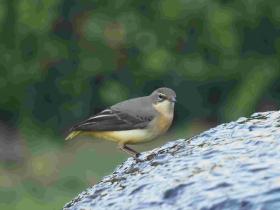
In the Vine House Farm garden, we have a water feature where water trickles over a big stone and nearly every week, outside of the breeding season, we get a Grey wagtail that visits. It is the Wagtail with the longest tail, that it does like wagging, and a grey back with yellowish undersides. It comes for bits and pieces in the water and never goes near the feeders. They breed close to running water, especially near waterfalls.
I have planted a lot of Cotoneaster and Pyracantha bushes to provide food for Blackbirds during the winter. There are far too many for the Blackbirds, but they are not going to waste as Pigeons have been tucking into them. Pigeons, being quite a heavy bird, cannot reach them all, but they have already eaten all they can reach and left plenty for Blackbirds. Maybe the Pigeons will come back for the more difficult ones if they get hungry.

Related Articles