

Despite the cool first half of the month, June was the second warmest June I have recorded, with a mean of 18.16°C, only June 2025 being warmer. The warmest day was the 26th, at 35°C and that equalled the previous high in June which was the same day in 1976. Rainfall was only just below the June average of 49mm, at 43mm, but you couldn’t see where it went as it had been so dry at the end of May.

There were a few days earlier in the month when we weren’t irrigating, but it has been nonstop since. We must have a wide rotation with potatoes, which is what we are mainly irrigating, and it is best to only grow them one year in eight for maximum yields. To get a good marketable sample on our land, we need to irrigate; some fields are near to water, and some are not. Those that are not near any water require lots of aluminium pipes laid to get water to the field.
The water we use to irrigate comes from the River Welland. Our local drainage board, the Welland and Deepings Internal Drainage Board, has a licence to let water out of the Welland into its dykes and ditches. We can use this water to irrigate our crops if we have a licence. We must record each day how much water we have used via a water meter on our pump. There’s a maximum amount that can be used each day and each year, with large fines if we should exceed these amounts.
Meanwhile, we have still been marketing last years potato crops which are all in cold store. The hot weather means that our fridges are running longer and so there are extra costs in keeping them cool.
At the start of June, my wife Anne and I went to North Norway, travelling all the way by train. We left Lincolnshire with the spring barley in ear and when we arrived at the Arctic circle, the spring barley was only 3ins high.
All the way through France, Belgium, Germany, Denmark and Sweden there were very few farms over 500 acres, with field sizes mostly only about 20 acres. As we went north forestry increased, arable land and grassland decreased.
I was surprised to see a herd of Hereford cattle in a field at 65°N and visited one of the most northerly dairy farmers at 70°N. When she took over from her father 20 years ago, she was only getting one cut of silage a year but because of global warming she is now getting two cuts a year from most fields and 90p per litre for her milk (35p/litre here).
In every city we stayed at we could hear Swifts and House Sparrows, right up to the Arctic circle. When the railway came to an end, we hired a car and went further North to Varanger Fiord. House Sparrows were chirping wherever there were houses and at 70°N I saw a Tree Sparrow, Wood Pigeons and plenty of Blackbirds which were quite common, but the most common bird was the Fieldfare. Of course, we weren’t there for the common birds, we went to see the breeding waders, and especially the Ruff leks which are communal arenas where male Ruffs gather to display, dance, and compete for the attention of visiting females.
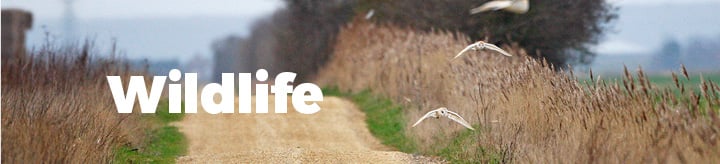

The unsettled cool weather at the start of the month took its toll on Barn Owls, as they were unable to hunt successfully in rain or wind. They hunt by sound, and moving voles can’t be heard when raindrops are pattering on the grass or when the wind is blowing. Significantly, the Barn Owl is one of the few bird species that doesn’t have waterproof feathers. This is because they don’t need them, and I suspect it takes more energy to grow a waterproof coat than one that is only shower proof.
I think every brood of Barn Owls in the district lost a chick during the first two weeks in June. If the youngest of the brood was small enough, it was probably eaten. If the hungriest chick stood at the nest entrance lost its balance and lay dead on the ground near the nest site, the smallest chick would then become the hungriest chick, as it would only get a vole whenever its larger brothers and sisters didn’t want one.
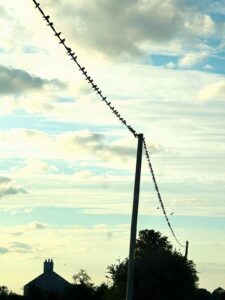
We have an increase in Swallows on the farm; we now have six pairs at Baston Fen instead of three, compared to three years ago, because of our free-range chickens. Such welcome news to have an increase of insect eating birds. They fledged their first brood at the end of June so will have time to have a second brood. Elsewhere they are in decline, and this is the first year there has not been a pair of Swallows nesting under the bridge that crosses the North Drove on Vine House Farm.
A pair of Reed Warblers has fledged a brood of four in the Café pond, only 10 yards from the deck, where people are; they should also go on to have a second brood. They have been very quiet about their occupation of the reed bed, so quiet that I thought they’d left the pond, after singing for a few days in the middle of May. I suppose there was no need to sing once he had attracted a mate and there are no other Reed Warblers to compete with, as there just isn’t room for a second pair at the pond.
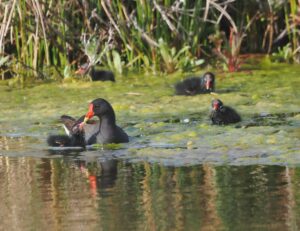
On the whole, Tree Sparrows are not doing well, our colonies are declining. Those that are still breeding are having big broods, but some have only had a first brood and have not started a second brood yet. This has also happened with the Moorhens on the Vine House Farmhouse pond. Birds, like us, get too old to breed or lose the zest. Young Tree Sparrows disperse from their breeding grounds around the middle of September, a few only go a mile or two to one of our other colonies, but most go much further. Our colonies rely on birds coming in from other colonies, but as there are so few other breeding Tree Sparrows around, we’re not getting many replacements.
Our heap of gravel has again been colonised by Sand martins, with around 70 pairs. During the last 10 days in June., most of the young fledged but were still flying around the gravel heap.
The Terns and Black Headed gulls nested on our Tern raft, but weren’t successful. All their eggs disappeared. To investigate further, I put two hens eggs on the raft monitored by a camera and on the next day there was the culprit – a Carrion crow eating the eggs.
Related Articles